Is That Tree in Your Yard a Hidden Hazard? Here's What to Look For
A tree can stand quietly for decades and give almost no trouble, then change character in a single season. Roots weaken underground where you cannot see them, decay hollows out a trunk that still looks solid from the driveway, and a canopy that shaded the yard all summer starts dropping limbs that were never meant to fall. By the time a tree fails outright, the clues were usually there for weeks or months. The trick is knowing what those clues look like before wind, saturated ground, or plain old age forces the issue.
This is a walk through the visible warning signs that a mature tree has crossed the line from healthy to hazardous, and what each one tends to mean about the wood, roots, and structure you cannot inspect directly. You do not need climbing gear or a resistance drill to spot most of these. You need to know where to look and what a red flag actually looks like on the ground.
Quick Answer: The most reliable hazardous tree signs you can see from the yard are a new or worsening lean, heaved or cracked soil near the base, cavities and soft or hollow wood in the trunk, vertical or horizontal cracks, fungal conks or mushrooms on the trunk and root flare, large deadwood and hanging limbs in the canopy, thinning foliage and dieback at the branch tips, and tight forks where two stems press together with bark trapped between them. Any one of these earns a closer look, and several together usually mean the tree needs a professional assessment before the next storm.
Start With the Lean and the Ground Around It
Before you study the trunk or the canopy, step back and look at the whole tree against something vertical. A house corner, a fence post, or a utility pole makes a good reference line.
A New or Worsening Lean
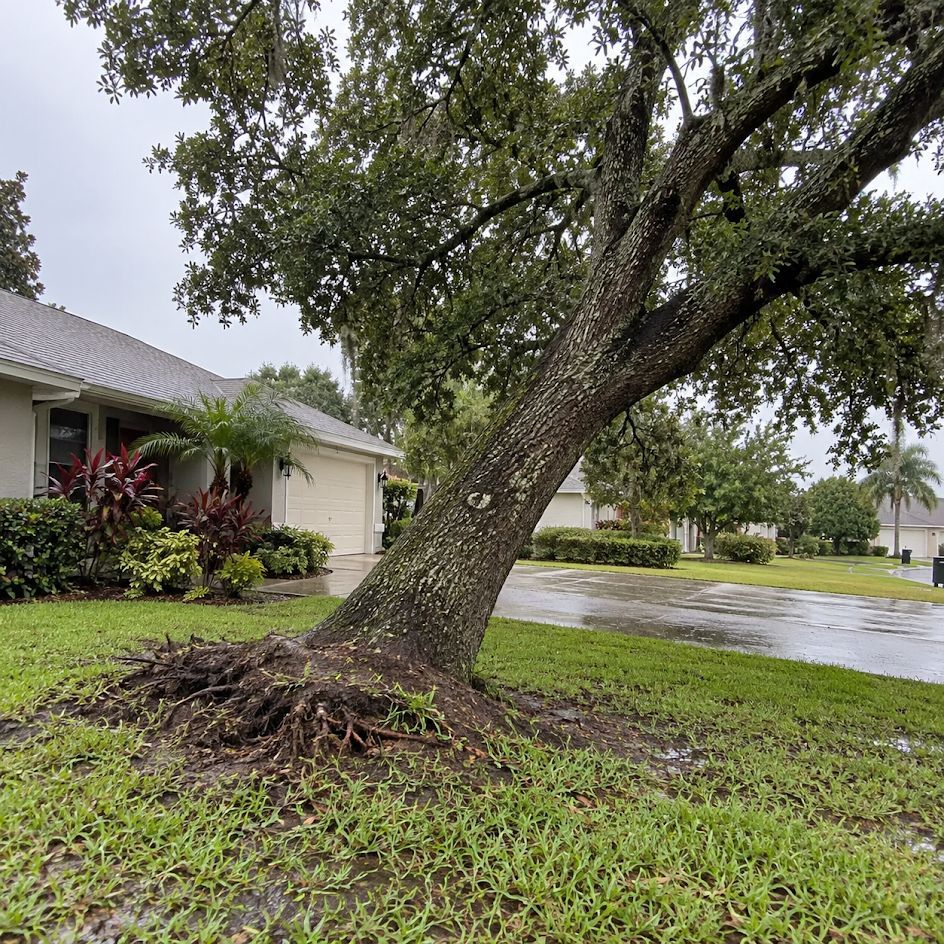
Plenty of trees lean a little and always have. A gradual, established lean with a trunk that has grown to compensate is usually not the emergency. The lean that should worry you is the one that appeared recently or is getting steeper, especially if it points toward a house, a driveway, or a spot where people gather.
A fresh lean almost always traces back to the roots. When the anchoring roots lose their grip, whether from rot, past digging near the base, or soil that has stayed wet too long, the tree begins to tip because nothing is holding the far side down. That is a very different problem from a tree that simply grew crooked reaching for light. A worsening lean is one of the clearest signals that failure has already started underground.
Heaving Soil and Lifted Roots
Walk to the base and look at the ground on the side opposite any lean. Soil that is cracked, mounded, or lifted, or roots that suddenly sit higher than they used to, tells you the root plate is rotating out of the earth. On a tree that is starting to uproot, the ground on the tension side bulges up while the far side sinks. Exposed, damaged, or visibly rotted roots at the flare add to the concern, because the base is where the whole tree transfers its weight into the ground. When that connection is failing, the rest of the tree does not matter much.
Read the Trunk
The trunk carries every pound of the canopy. Small defects there scale up into big risks, so it pays to walk a slow circle around it and actually put your eyes on all sides.
Cavities, Hollows, and Soft Wood
Openings, holes, and cavities in the trunk usually mean the wood inside is decaying. Not every cavity spells doom. Some are old wounds the tree has walled off and grown around successfully. The ones that matter have rolled edges, ongoing softness, or a large share of the trunk's cross section eaten away. Tap around a suspected hollow and you may hear a drum-like sound where solid wood should be. Where bark is missing and the wood underneath is soft, crumbly, or damp, decay is active and the trunk has lost strength it will not get back.
Cracks and Seams
Vertical cracks running up the trunk and deep horizontal cracks are both serious. A vertical seam can mean the trunk is splitting along its grain, often where an old included fork or internal decay has weakened it. Cracks that pass through into a major branch union, or two cracks facing each other on opposite sides of the trunk, suggest the trunk could come apart under load. Fresh cracks after a windstorm deserve immediate attention, because the wood has already been overstressed once.
Fungal Conks and Mushrooms
Mushrooms, shelf-like brackets, and hard conks growing on the trunk, at the root flare, or on the surface roots are among the most telling signs of trouble. Fungi that fruit on the wood are feeding on it, which means decay is already established inside where you cannot see it. A ring of mushrooms in the soil around the base can point to root rot doing the same job underground. The fruiting body is the visible tip of a much larger problem, and its presence on a stem or root flare generally means the structural wood there is compromised.
TIP: Photograph anything questionable from the same spot every few weeks. A lean, a crack, or a soil bulge is hard to judge from memory, but side-by-side photos make slow movement obvious long before it becomes dramatic. Date each shot so you can show a professional exactly how fast things are changing.
Look Up Into the Canopy
The top of the tree tells you how well the roots and trunk are still doing their job of moving water and holding weight. Pick a bright day and study the branches against the sky.
Deadwood and Hanging Limbs
Large dead branches are a direct falling hazard on their own, and they also hint that the tree is losing the ability to sustain its whole canopy. Bare, brittle limbs with no leaves in season stand out against the green. Watch especially for broken branches that have hung up in the crown instead of falling all the way to the ground. These lodged limbs can drop without warning, and they tend to sit over the exact places you use most: doorways, walkways, patios, and parking spots.
Thinning Canopy and Dieback
A canopy that is noticeably thinner than the trees around it, or thinner than it was last year, signals decline. Dieback that starts at the branch tips and works inward often means the roots can no longer supply the crown, which loops back to root damage or decay in the trunk. Off-season color, undersized leaves, and whole sections of the crown that leaf out late or not at all are all worth noting. A tree in steady decline becomes more brittle and less predictable every season it hangs on.
Structural Flaws Built Into the Tree
Some hazards are not damage or disease at all. They are the shape the tree grew into, and they get more dangerous as the tree gets bigger and heavier.
Co-Dominant Stems and Included Bark
Look at the main forks. A strong union is U-shaped, with the two limbs joined by a solid web of wood. A weak union is a tight V, where two stems of similar size press against each other with bark pinched in the crack between them. That trapped bark, called included bark, means the stems never truly fused. They are held together by geometry more than by wood, and unions like this are classic failure points when a heavy canopy catches the wind. On a large tree, a co-dominant split can send half the crown to the ground in one gust.
How Central Florida Conditions Raise the Stakes
The same defect that a tree might carry harmlessly for years in a calm climate gets tested hard here. Central Florida stacks several stressors on top of whatever a tree is already dealing with.
Species matters. Laurel oaks and water oaks are common across Polk County yards and grow fast, but they are relatively short-lived and prone to internal decay as they mature, often beginning to hollow and drop limbs by the time they reach middle age. Their tendency toward tight, included-bark forks makes them frequent storm casualties. Sabal palms, by contrast, are famously wind-firm and rarely fail the way a decayed hardwood does, which is a reminder that not every tall tree near your roof carries the same risk. Knowing which species you are looking at helps you weigh what you see.
Then there is the weather. Long rainy stretches and tropical systems saturate the sandy soils around Lakeland, Winter Haven, Haines City, Bartow, and Lake Wales until the ground loses its grip on the roots. Fully soaked soil behaves almost like a thick liquid, and a tree rocking in high wind can pull its whole root plate loose from earth that would have held firm when dry. Add hurricane-force gusts loading a heavy, decayed, or poorly structured canopy, and a tree that looked fine in June can come down in a September storm. This is why the combination of a marginal tree and saturated ground is far more dangerous than either factor alone.
WARNING: Never test a suspect tree by pushing on it, climbing it, or working under it in wind. A tree with root or trunk failure already underway can come down with very little added force and no useful warning. Keep people, vehicles, and gathering spots out from under anything showing these signs until someone qualified has looked it over up close.
Frequently Asked Questions
Can a tree look completely healthy and still be a hazard?
Yes. Decay works from the inside out, so a trunk can be substantially hollow while it looks normal outside. Subtle signs, a slight lean, a bracket fungus, a hairline crack, deserve attention before something obvious happens.
How much lean is too much?
Context matters more than degrees. A long-standing lean on a sound tree can be stable, but a new or worsening lean with cracked or heaved soil is dangerous. Movement is the real warning, since a changing lean means failing anchorage.
Do mushrooms at the base always mean the tree has to come down?
Not automatically, but never ignore them. Fungal growth indicates active decay, and the real question is how much sound wood remains. That takes hands-on evaluation, since some trees can be managed while others are past saving.
Are fast-growing shade trees more likely to become hazards?
Often, yes. Quick-growing hardwoods tend toward weaker wood, more decay as they age, and tight forks that fail under load. They give great shade early but can become higher-maintenance risks later, rewarding closer inspection as they mature.
What should I do the moment I notice several of these signs together?
Keep the area clear, avoid disturbing the tree, and arrange a professional look soon. Multiple signs together, like a lean plus soil heave plus fungal growth, mean several systems may be failing at once, raising failure risk.
Read the Signs Before the Storm Does
Hazard trees rarely fail out of nowhere. They lean a little more, crack a little wider, thin at the top, or sprout a bracket fungus long before they hit the ground. Learning to read those signs turns a nasty surprise into a manageable decision made on your own timeline instead of the storm's. Walk your property now and then, and treat any cluster of warning signs as a prompt to get a closer, qualified opinion.
With 10+ years assessing trees across Lakeland, Florida and the surrounding Polk County area, Trees and More
knows how sandy soil, saturated ground, and species like laurel oak raise the stakes here. If you've spotted a lean, a cavity, deadwood, or fungus on a tree near your home, reach out for an on-site hazard assessment and a clear plan for what comes next.